
Archives
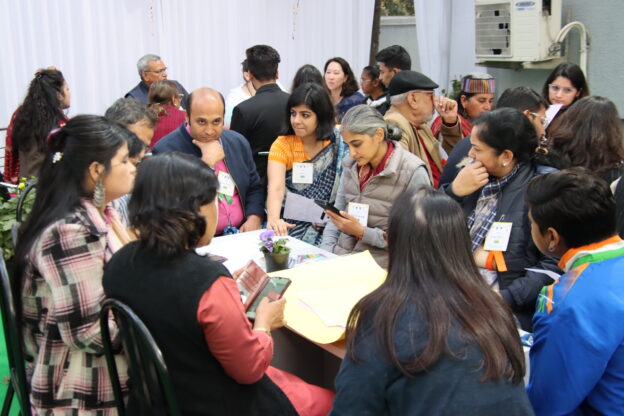
Action Learning
What is Action Learning?
Action learning is a problem-solving approach developed by organisational theorist Reg Revans in the 1940s, built on a deceptively simple observation: people learn most from grappling with real problems and reflection on what they discover in the process.
At its core, it combines two elements – taking action on a genuine challenge, and then pausing to question, reflect, and learn collectively from that experience.
It is distinct from case-study learning or simulations. The problem being worked on is live, the stakes are real, and the learning is inseparable from the work.
Why Action Learning is Used?
Action learning helps to develop capabilities that conventional training struggles to reach. It encourages teamwork, critical thinking, leadership, and problem-solving.
Facilitating a difficult meeting, navigating institutional resistance, and deciding under uncertainty – these competencies are not transferred through lectures.
When & Where Action Learning is Applied?
Action learning has been applied across sectors and contexts for decades. In organisational development, the goal is to build leadership capability at every level by creating structured conditions in which they lead real work and reflect on it.
In the development sector, it occurs in capacity-building programmes, community governance initiatives, and staff development processes where practitioners must navigate complex, changing situations.
The method is especially well-suited to settings where the challenges are locally specific, where hierarchies of expertise are unhelpful, and where the people closest to the problem often hold the most useful knowledge, but need structured support to surface and apply it.
How Action Learning Works?
The engine of this process is the Action Learning Set: a high-trust, disciplined, typically group of four to eight people, called an Action Learning Set. The set meets regularly over a period of time.
During each session, one or more members bring a live challenge they are working on. The group does not jump to solutions. Instead, members ask questions: What have you tried? What are you assuming? What would change if that assumption were wrong?
This questioning process is central – it is how the person with the problem thinks more clearly and how the group learns collectively.
Between sessions, participants act on what they have learned by testing new approaches, gathering information, and making decisions. They bring the results back to the set, where the cycle of questioning, reflection, and action begins again.
A facilitator, sometimes called a set advisor, supports the process without directing the content.
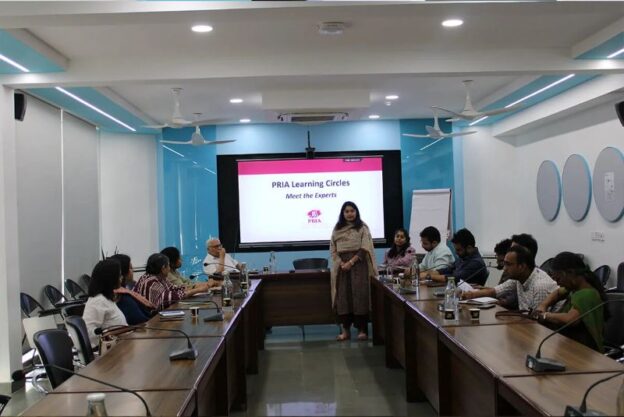
Active Citizenship
What is Active Citizenship?
At PRIA, we see it when a village Gram Sabha moves beyond formality to conduct a real social audit, or when urban collectives demand dignity in housing and sanitation. It is the transition from being a passive “beneficiary” to a rightful claimant.
For 44 years, we have championed this as Participatory Governance. Whether through monitoring public works or engaging elected officials, active citizenship is the “connective tissue” that ensures institutions remain accountable.
Why Active Citizenship is Used?
Governance systems, however well-designed on paper, do not function well without citizens who are willing and able to engage with them.
PRIA’s four decades of work at the interface of citizens and local institutions have consistently returned to the same observation: when communities are active participants in planning, budgeting, and accountability processes, outcomes improve.
When they are passive recipients, even the best-resourced schemes underdeliver.
Active citizenship matters because accountability is not self-enforcing. Elected representatives respond to organised, informed citizens who track what was promised and what was delivered.
When & Where Active Citizenship is Applied?
At PRIA, we’ve learned that active citizenship doesn’t live in a manifesto – it lives in the streets, the fields, and the community halls.
In the village where we’ve worked since the 1980s, active citizenship isn’t an abstract concept – it’s a Gram Sabha where the back row stands up to speak. It’s a group of neighbors conducting a social audit, physically measuring the quality of a new road to ensure the budget was spent honestly.
In the informal settlements and growing wards of our cities, citizenship looks like the “Engaged Citizens, Responsive City” model. It’s the formation of settlement-level committees that allow residents to map their own infrastructure, showing the municipality exactly where sanitation and housing gaps are.
How Active Citizenship Works?
Active Citizenship involves individuals taking proactive responsibility for their communities and democracy through engagement, voluntary action, and advocacy.
Awareness comes first: It’s about a mother in a basti or a farmer in a distant village understanding exactly which office holds the budget for their water, and who is accountable when the taps run dry.
When people have the facts, they stop being “beneficiaries” waiting for a handout and start being rightful claimants of their own future.
Knowledge without a place to use it only leads to frustration. We’ve spent years pushing for Participatory Spaces, ensuring that Gram Sabhas aren’t just paper formalities and that Ward Committees actually have chairs for the marginalized.
Active citizenship can’t breathe if the doors to local governance are locked. We work to unlock those doors so that the “invited spaces” of government become “claimed spaces” for the people.

Arts-Based Methodologies
What if a play, a painting, or a story could spark social change? That is the promise behind arts-based methodologies. Below, we walk through what the term means, why people use it, how it works on the ground, and where you can see it making a real difference in communities today.
What Are Arts-Based Methodologies?
Arts-based methodologies use creativity to explore, teach, and talk about the things that matter to a community. A mural, a street play, or a shared story becomes a way to dig into an issue rather than just decorate it.
More formally, arts-based methodologies are approaches that use creative expression such as theatre, visual arts and storytelling as mediums for research, learning and social engagement. They are used because some truths land harder through a song or a scene than through a report nobody reads.
Why It Matters
Not everyone connects with statistics and policy papers.
- Arts-based methodologies take complex social issues and make them relatable, so more people can join the conversation.
- They also bridge the gap between theory and understanding.
- A community, a group of policymakers, and an institution rarely speak the same language, but a piece of theatre or a set of images can hold all three in one room.
- On top of that, they turn research and learning into something shared and participatory, where people are part of the work instead of just its subject.
How It Works
The forms are wide open. Theatre, visual arts, and storytelling sit at the centre, though film, music, and photography often join in too. Each one gives people a different way to speak.
These forms get applied across three areas: research, where art surfaces things surveys miss, learning, where it makes lessons stick, and social engagement, where it pulls people into action. The real strength is connection. A performance or exhibition can carry a community’s lived reality straight to policymakers and institutions who might never have heard it otherwise.
Real-World Examples
The clearest examples come from work rooted in real neighbourhoods.
- Community theatre has long been used in Indian villages to open up talks on caste, gender, and health, letting audiences rehearse change before living it.
- Mural projects across cities have handed public walls to residents, turning blank concrete into a record of local identity and protest.
- Storytelling initiatives, where elders and youth swap memories, have preserved knowledge that no archive was capturing, while quietly bonding a community across generations.
Key Takeaway
Arts-based methodologies are creative tools for social dialogue. When a play, an image, or a story carries a message, it reaches places a report cannot, turning silent issues into shared conversations that move people to act.
Explore More
Found this useful? Bookmark this page and pass it on to anyone working in research, education, or community work. To go further, browse related glossary terms such as Experiential Knowledge and Grassroots Leadership, both of which sit closely alongside how creativity drives change from the ground up.
You can also read more in our blog post, Reflections from an Arts-Based Learning Circle.
C

Citizen Participation
Citizen participation is an important part of democratic governance and inclusive development. It refers to citizens’ involvement in decisions that affect their communities and public institutions.
It creates opportunities for people to share their perspectives, contribute to decision-making, and engage with governance processes at different levels.
Citizen Participation helps strengthen the relationship between communities and institutions by encouraging dialogue, collaboration, and shared responsibility.
What is Citizen Participation?
In simple terms, it means people get involved in the decisions, plans, and processes that shape their own lives – rather than simply receiving whatever is decided for them.
Formally, citizen participation refers to the active involvement of individuals, especially marginalised groups, in decision-making, monitoring, policy dialogue, and participatory research.
It exists because people are more likely to support and engage with decisions when they have opportunities to contribute to the processes that shape them.
Why Citizen Participation Matters
Citizen participation helps ensure different perspectives and experiences, creating opportunities for marginalised and underrepresented groups.
It also helps strengthen trust between citizens and institutions while supporting more responsive policies and programmes.
How Citizen Participation Works
Citizen participation can take any form depending on the context and purpose.
Common approaches include community meetings, public consultation, surveys, participatory planning exercises, public hearings, and local forums. These processes may involve individual citizens, community groups, civil society organisations, and representatives of marginalised communities.
The insights and feedback generated through these processes can help shape policies, programmes, services, and local development initiatives.
Examples in Practice
- Gram Sabha Meetings, India
Under the Panchayati Raj System, Gram Sabha meetings serve as the primary statutory forum for village residents to exercise fiscal oversight, review development activities, and raise priorities directly with elected representatives.
PRIA has worked with Panchayati Raj Institutions across different states to strengthen citizen participation, build the capacities of elected representatives, and promote more inclusive local governance.
- Participatory Budgeting (Kerala, India) (Source)
Through the people’s plan campaign, village assemblies directly debate and decide how to spend large portions of local development funds, prioritising local schools and water systems.
- Community Monitoring, PRIA
Communities across India have participated in monitoring public services, from tracking mid-day meal delivery in schools to reviewing the functioning of health facilities.
Pria has been at the forefront of supporting these efforts, training and enabling communities to actively engage with local officials.
Key Takeaway
Citizen participation strengthens democracy by creating opportunities for people to contribute to decisions that affect their communities and public institutions.
It helps make governance processes more inclusive, responsive, and connected to local realities.
Want to Know More?
Citizen Participation is closely connected to concepts such as civic engagement, participatory governance, social accountability, and community mobilisation.
Explore related glossary terms to learn more about how citizens and institutions work together to support inclusive and responsive governance.

Citizen Report Card (CRC)
Citizen report cards (CRCs) are a widely used tool for gathering feedback from citizens about the quality, accessibility, and effectiveness of public services.
They provide a structured way for people to share their experiences of services such as healthcare, education, transport, water supply, and municipal administration.
It helps create opportunities for dialogue between citizens and public institutions by bringing citizen feedback into discussions on service delivery and governance.
What is a Citizen Report Card?
In simple terms, a citizen report card is a survey-based tool for assessing the performance of public services.
It is a social accountability tool that gathers citizen feedback on public services and brings community experiences into discussions on service delivery.
The findings can help identify concerns, improve communication between citizens and institutions, and support efforts to improve public services.
Why does it matter?
Monopolistic public service providers often operate in isolation, disconnected from the daily realities of the people they serve. A CRC breaks this monopoly of silence by giving everyday citizens a structured voice.
They provide evidence to highlight service delivery gaps, identify areas for improvement, and draw attention to issues that might otherwise go unnoticed.
The findings can support constructive dialogue between citizens, service providers, and decision-makers, contributing to a more responsive governance process.
How Citizen Report Cards Work
CRC typically collects feedback through surveys, interviews, and community consultations.
Questions cover satisfaction, accessibility, reliability, and the handling of complaints. The data is then compiled, analysed, and presented in a clear format that non-specialists can read and use.
The results can be used by institutions, service providers, and communities to review performance, address concerns, and improve service delivery.
Examples in Practice
- Bangalore Citizen Report Card (Source)
The Public Affairs Centre (PAC) conducted the first CRC globally in 1994, surveying Bangalore residents on city services, including water, electricity, and public transport. It became one of the earliest and most widely recognised examples of citizen-led assessment of government services.
- Delhi CRC initiative (Source)
The Public Affairs Foundation (PAF) – the specialised sister organisation of Public Affairs Centre (PAC) gathered user-experience metrics from thousands of residents across slum clusters, unauthorized colonies, and urban settlements.
- CRC in Karnataka (source)
Citizen Report Cards have been used in different parts of Karnataka to gather feedback on services such as healthcare, education, and local administration. Community members shared their views on the services they use and the challenges they face. This information helped public institutions understand issues that mattered to local communities.
Key Takeaway
Citizen Report Cards bring citizen feedback into conversations about public services and how they can be improved.
They help strengthen the connection between citizen feedback, institutional learning, and public accountability.
Want to Learn More?
Citizen Report Cards are closely linked to concepts such as Social Accountability, Citizen Participation, Participatory Governance, and Public Accountability.
Explore related glossary terms to learn more about the tools and approaches that support responsive and inclusive governance.
Coalition Building
A community organisation may understand an issue closely but have limited access to policymakers. A research group may have strong evidence but little grassroots reach. An advocacy organisation may know how to build public attention but need credible data to support its case.
Coalition building brings these different strengths together around something they all want to change.
What Is Coalition Building?
Coalition building is the process of bringing together different organisations, groups, or individuals to work towards a shared goal.
Coalitions are often formed around issues that are difficult for one organisation to address alone, such as workers’ rights, gender equality, environmental protection, access to healthcare or changes in public policy.
Importantly, coalition members do not have to agree on everything. A trade union, community organisation and legal advocacy group, for example, may have very different priorities in their everyday work. But if all three want stronger protections for informal workers, that common goal can give them a reason to work together.
Some coalitions last for a particular campaign. Others continue for years as the issue, and the workaround for it develop.
Why Does Coalition Building Matter?
There is strength in hearing the same concern from different parts of society.
When community groups, researchers, professionals and civil society organisations raise an issue together, they can bring different kinds of evidence, experience and influence to the conversation.
They can also share resources. One member may conduct research, another may have strong relationships within communities, while someone else understands policy processes or public communication.
Instead of duplicating efforts, a coalition can connect these strengths and build a wider base of support.

How Does Coalition Building Work?
A coalition usually begins with common ground: What change does everyone around the table want to see?
Members then decide what they can realistically achieve together and what each participant can contribute. Responsibilities may include community mobilisation, research, advocacy, communication, legal support or engagement with policymakers.
The harder part often comes later.
Different organisations have their own priorities, working styles and expectations. They may disagree about strategy, visibility, funding or how quickly to act. Successful coalition building, therefore, also depends on trust, clear communication and a willingness to negotiate differences without losing sight of the shared goal.
What Does Coalition Building Look Like in Practice?
Imagine informal workers seeking better workplace protections. Worker collectives may bring first-hand experience of unsafe conditions, legal organisations can explain gaps in existing protections, and researchers can document patterns across a larger group.
Working together gives them a stronger evidence base and a wider platform from which to engage decision-makers.
Similar coalitions can form around environmental concerns, public health, education, gender rights or access to essential services.
Key Takeaway
Coalition building is about turning separate strengths into collective action. It allows groups with different experiences and capabilities to work towards a common purpose while recognising that they do not need to agree on everything to achieve something together.
Explore the PRIA International Academy to understand how coalition building connects with advocacy, participatory governance and collective action.

Community Development Programmes
What does it take to build a community that can shape its own future?
The answer rarely begins with a single project or policy. More often, it begins with people coming together to identify local priorities, share responsibility and make collective decisions about the future they want. This is the idea behind Community Development Programmes. In this glossary, we explore what community development programmes are, why they matter, how they work, and how they help communities become active partners in development rather than passive recipients.
What are Community Development Programmes?
Community Development Programmes are initiatives that are aimed at strengthening rural and urban communities through decentralised planning, capacity building, and participatory governance. They exist to ensure that development is shaped not only by policies and institutions, but also by the people whose lives those decisions affect, embedding democratic practices into everyday development.
Why does it matter?
Strong communities are built through participation, not simply provision. Community Development Programmes create opportunities for people to contribute to decisions that influence their daily lives, whether in villages, towns or cities. By strengthening local leadership, improving planning capacities and encouraging shared responsibility, these programmes help communities respond to challenges with greater confidence. In doing so, they make democratic participation an everyday practice rather than an occasional event.
How It Works?
Community Development Programmes bring together community members, local institutions, civil society organisations and public authorities to address shared priorities. Through decentralised planning, communities identify local needs and help shape development plans. Capacity-building activities strengthen the skills of community leaders, institutions and citizen groups, while participatory governance encourages dialogue, collaboration and accountability. Together, these partnerships translate local knowledge into practical actions that respond to real community needs.
Real-World Examples
A village community may work alongside the local government to prepare a participatory development plan that reflects local priorities for water, education and livelihoods. In urban neighbourhoods, resident groups and municipal authorities may collaborate to improve sanitation, public spaces or access to essential services.
PRIA’s climate adaptation work in Ajmer and Jodhpur shows this kind of collaboration in action: Self-Help Group women and youth were trained to map and monitor local water bodies as part of a climate resilience initiative, and their findings were significant enough that municipal officials acknowledged real gaps in their own records. These community members went on to sit on City Level Advisory Committees and form Neighbourhood Water Committees, working alongside local government on ongoing monitoring and maintenance rather than replacing its role. Community Development Programmes also support partnerships where civil society organisations, local institutions and citizens work together to strengthen local governance, encourage participation and improve the quality of development outcomes .
Key Takeaway
Community Development Programmes place communities at the centre of development, enabling people to participate, collaborate and lead the decisions that shape their collective future . A core part of this is building the skills within communities themselves, so that the impact of these programmes lasts well beyond the project’s own timeline.
Continue Learning
If you found this helpful, consider bookmarking it and sharing it with others interested in participatory development and community engagement. If you’d like to build these skills further, PIA’s course, Participatory Research: A Journey Beyond Conventional Research, offers a practical grounding in the kind of community-led research this glossary describes. You may also enjoy exploring related terms such as Decentralisation and Participatory Governance, which further explain how communities and institutions work together to create more inclusive and democratic development processes .
Community-Based Participatory Research (CBPR)
What is Community-Based Participatory Research (CBPR)?
Community-based Participatory Research is a form of research in which communities are genuine partners in the research process, rather than passive subjects.
The term was developed to describe an approach that deliberately shifts the relationship between researchers and communities, away from extraction and towards collaboration.
In CBPR, community members help define what is worth studying, participate in designing the study, collect and interpret data alongside trained researchers, and have a say in how findings are communicated and acted upon.
CBPR applies those principles specifically in settings where the research is connected to real community health, social, or development challenges, and where community ownership of the process and findings is treated as both ethically necessary and practically important
Why Community-Based Participatory Research is Used?
The core argument for CBPR is that conventional research, designed and conducted by external experts, systematically misses things. It misses them because the questions it asks are shaped by what researchers already believe matters.
It misses them because communities are more likely to share honest information with people they trust. And it misses them because the knowledge that shapes how a problem is understood often lives in the community, not in the literature.
CBPR also produces research that is more likely to be used. When communities have been part of defining the question and interpreting the findings, they have a stake in the outcomes.
For practitioners in governance, healthcare, education, and social development fields, where research needs to translate into changed practice and policy, this is not a secondary benefit. It is the point.
When & Where Community-Based Participatory Research is Applied?
CBPR is mostly used in settings where a research question cannot be answered well without the active involvement of the local community it concerns.
In public health, it has been used to understand why communities do not use available services, what barriers exist to healthcare access, and how health programmes need to be redesigned to reach people who need them most.
In urban development, it has been used to generate community-produced data about informal settlements – data that municipalities and planners do not have and collect on their own.
PRIA’s own work illustrates this across decades, from supporting adivasi communities in the 1980s to document the impact of displacement, to the engaged citizens, responsive city programme, in which settlement improvement committees in Ajmer, Muzaffarpur, and Jhansi conducted Participatory Settlement Enumeration and produced data that directly informed city-wide sanitation planning.
How Community-Based Participatory Research Works?
CBPR does not follow a single fixed methodology, but it consistently involves a few core practices.
Researchers and community members build a genuine partnership first to establish trust, shared purpose, and agreement on what needs to be understood.
The process closes with action: findings are used to inform policy, advocacy, or practice, with communities involved in deciding how.