Author Archives: priaacademy_admin

From Scheme Implementation to Local Problem-Solving

From Gram Swaraj to Local Self-Government: The Unfinished Journey of Decentralisation in India

India’s journey towards decentralisation has been long and uneven. From Mahatma Gandhi’s idea of Gram Swaraj to the constitutional recognition of Panchayati Raj Institutions (PRIs), the aspiration has remained clear: people should have a greater say in decisions that affect their lives and communities.

More than three decades after the 73rd Constitutional Amendment, Panchayats have become one of the world’s largest systems of elected local government. Yet an important question remains: have Panchayats become institutions of local self-government, or do they still largely function as implementing agencies of higher levels of government?

Decentralisation is not simply about moving administrative responsibilities downward. It is about bringing decision-making closer to citizens and enabling local institutions to respond to local priorities.

From Gram Swaraj to Constitutional Local Government

The idea of village self-government has deep roots in India’s political thinking. Gandhi’s conception of Gram Swaraj placed the village at the centre of democratic life. Article 40 of the Constitution similarly directs the State to organise village Panchayats and provide them with the powers necessary to function as units of self-government.

The decisive institutional shift came with the 73rd Constitutional Amendment in 1993. It gave constitutional status to Panchayats, established regular elections, provided reservations for women and disadvantaged communities, recognised the Gram Sabha, and identified 29 subjects in the Eleventh Schedule for possible devolution.

The amendment therefore did more than create another administrative tier. It placed Panchayats within India’s democratic architecture as institutions of local self-government.

More Reads: Understanding Panchayati Raj Institutions (PRI): Decentralisation, Democracy and Local Governance

Three Decades of Local Democracy

The scale of this transformation is significant. According to the Ministry of Panchayati Raj’s Basic Statistics of Panchayati Raj Institutions 2025, India had 2,62,523 Panchayati Raj Institutions and 24,14,943 elected representatives as of 31 March 2025. Women accounted for about 48.4 per cent of elected PRI representatives.

These figures demonstrate the reach of grassroots democracy and the expansion of women’s political representation. But representation is only one dimension of decentralisation.

The more important question is: what can Panchayats actually decide, plan and influence?

More Reads: My First Field Visit in India: Reflections from Rural Chhattisgarh

From Representation to Real Devolution

Although the constitutional framework is common across India, actual devolution varies considerably between states. The Ministry of Panchayati Raj’s Devolution Index Report 2024 assesses Panchayats across framework, functions, finances, functionaries, capacity building and accountability. The national average score was 43.89, while Karnataka, Kerala and Tamil Nadu recorded the highest scores.

This variation highlights an important reality: constitutional recognition does not automatically translate into effective local self-government. The actual authority of Panchayats depends on the devolution of functions, finances, personnel and decision-making powers.

The Parliamentary Standing Committee on the implementation of the 73rd Constitutional Amendment has similarly highlighted uneven devolution and noted that Panchayats often continue to function primarily as implementing agencies.

Implementing a programme designed elsewhere is not the same as exercising local self-government.

More Reads: Why CBPR is the Future of Ethical and Inclusive Research

What Does Decentralisation Look Like on the Ground?

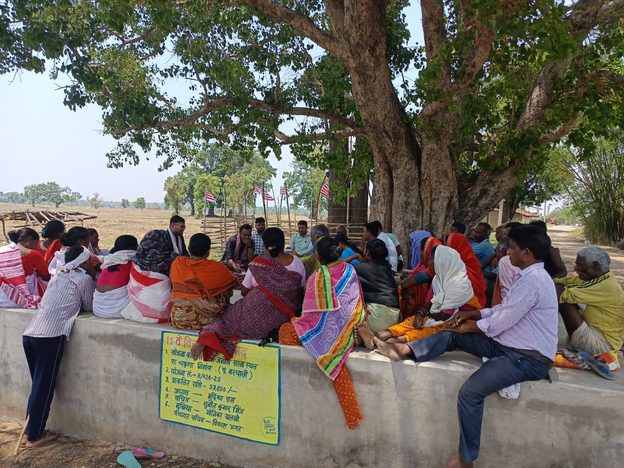
A recent field engagement in Garhwa, Jharkhand, as part of PRIA’s Co-Create initiative, brought this question into sharper focus.

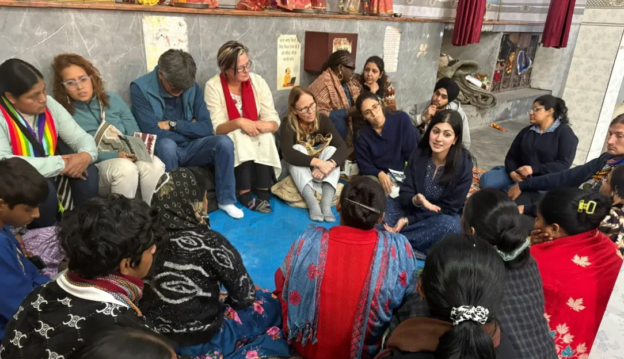
Interactions with communities and local stakeholders in villages including Suli, Chete and Jamouti explored local governance, Gram Sabha processes, water and climate concerns, migration, health, education and natural resources. Discussions also touched on the PESA Act, the Forest Rights Act and the relationship between community rights and formal governance institutions.

One observation stood out: the challenge facing Panchayats is not simply a lack of development programmes, but also the limited connection between local knowledge, community participation and formal governance processes.

In discussions in PESA areas, awareness of PESA provisions and community rights over jal, jungle, zameen remained limited among many community members and local representatives. Participation of migrant workers, women, youth and elderly people in Gram Sabha processes was also uneven.

At the same time, communities possessed rich ecological, cultural and livelihood knowledge that was not always reflected in formal planning. These observations are not representative of every Panchayat in Jharkhand or India. They nevertheless illustrate why decentralisation must be understood through the everyday relationship between institutions and communities, and not only through constitutional provisions or statistics.

More Reads: 5 Participatory Learning Methods and Action Techniques You Can Apply Today

Panchayats, Gram Sabha and Local Planning

This relationship becomes particularly important in local planning.

Water, sanitation, livelihoods, agriculture, health, migration and natural resources are often interconnected. The Gram Panchayat Development Plan (GPDP), therefore, should be more than a list of schemes. Ideally, it should provide a space where local priorities are identified, discussed and translated into collective plans.

Digital systems such as eGramSwaraj can support planning and monitoring, but technology cannot substitute for democratic participation.

The Gram Sabha remains central because elected representatives alone cannot constitute local self-government. Citizens need meaningful opportunities to deliberate, question priorities and influence decisions.

For those seeking to understand decentralisation, Panchayati Raj institutions, Gram Sabha and local governance, the PRIA International Academy course on Panchayati Raj and Decentralisation provides a useful learning resource covering these themes, including the constitutional framework and PESA. Explore the course

Resources Must Follow Responsibilities

From Scheme Implementation to Local Problem-Solving

Local self-government also requires financial and administrative capacity.

A Panchayat cannot meaningfully exercise responsibility without predictable resources, appropriate personnel and institutional authority. The issue is therefore not simply how much money reaches Panchayats, but whether functions, funds and functionaries are aligned.

Financial support alone cannot create local autonomy if Panchayats lack the authority and capacity to determine how local priorities should be addressed. Strengthening own-source revenue, administrative support and institutional capacity therefore remains important to the decentralisation agenda.

From Scheme Implementation to Local Problem-Solving

The next phase of decentralisation requires Panchayats to move beyond a scheme-by-scheme approach towards integrated local problem-solving.

A village’s water challenge may be connected to agriculture, sanitation, women’s work and livelihoods. Migration may be linked to employment, education and social protection. Climate risks may intersect with forests, agriculture, housing and health.

Panchayats are potentially well placed to bring these concerns together because they operate close to communities. But they need more than funds. They need information, technical support, capable functionaries and meaningful relationships with communities and other institutions.

The Garhwa experience also points to another important resource: local and Indigenous knowledge.

Communities possess knowledge about forests, water, agriculture, seasons, livelihoods and ecological change that formal administrative systems may not fully capture. Recognising this knowledge can make Panchayat planning more grounded and responsive, particularly in PESA areas where governance is closely connected with community rights, natural resources and cultural identity.

More Reads: How to Apply the Theory of Change for Greater Impact in Community Development

Deepening Decentralisation

India does not need to begin decentralisation again. It needs to deepen what has already been created.

Four shifts are particularly important:

  1. From formal devolution to substantive devolution: Panchayats need responsibilities accompanied by authority, resources and personnel.
  2. From participation as attendance to participation as influence: Gram Sabhas should be judged by whether citizens can influence priorities and hold institutions accountable.
  3. From scheme implementation to integrated local planning: Panchayats need the capacity to connect local evidence, community priorities and development programmes.
  4. From administrative knowledge to locally grounded knowledge: Community experience and Indigenous knowledge should be recognised as legitimate inputs into local governance.

These shifts also create opportunities for stronger partnerships between Panchayats, communities, civil society organisations and higher education institutions. Universities can contribute research, data and technical knowledge, while communities can bring grounded knowledge and lived experience into planning.

Making Decentralisation Meaningful

The history of Panchayati Raj can be understood as a movement through three broad stages: the idea of village self-government, the constitutional institutionalisation of Panchayats, and the still unfinished task of making these institutions capable of exercising meaningful authority.

India has created an extraordinary democratic infrastructure at the grassroots. But decentralisation should not be judged only by the number of Panchayats, elected representatives or meetings held.

The deeper questions are: Who decides? Whose priorities shape local plans? Who controls resources? Whose knowledge is recognised? Who participates in the Gram Sabha? And can Panchayats act on decisions made through these processes?

The answers will determine whether Panchayats remain primarily channels for implementing programmes designed elsewhere or become genuine institutions of local self-government.

The journey from Gram Swaraj to constitutional Panchayati Raj has transformed India’s democratic landscape. The next step is to bring authority, resources, institutional capacity, local knowledge and citizen participation together at the grassroots.

Decentralisation becomes meaningful when people are not merely beneficiaries of development, but participants in deciding what development should mean for their communities.

Explore all articles on the PRIA International Academy Blog.

strategic planning

Why Strategic Planning Matters for Civil Society Organisations in India

For many civil society organisations (CSOs), planning often involves preparing the next project proposal, setting annual targets, finalising budgets, or responding to a donor’s priorities. While these are important tasks, they are distinct from strategic planning.

Strategic planning necessitates a step back to ask fundamental questions: Who are we? Why do we exist? What changes do we aspire to see? Is our current work still relevant? And what should we do differently to remain useful and effective in an evolving world? It is a process of making decisions that shape and guide an organisation’s identity, actions, and purpose.

This distinction is particularly crucial for CSOs in India today.

Beyond project planning

Conventional planning typically begins with agreed goals, translating them into activities, timelines, and budgets. Strategic planning, however, starts deeper – with the organisation’s core purpose and its dynamic environment. It compels us to consider not only our current activities but also the changes occurring around us and their implications for our future.

For Indian CSOs, the operating environment has grown increasingly complex. Funding patterns are shifting, community expectations are evolving, government–civil society relationships are transforming, technology is revolutionising organisational operations, and new actors are entering the development sphere. Concurrently, the problems CSOs address – poverty, inequality, climate change, gender discrimination, exclusion, and democratic participation – are becoming more interconnected.

In such a landscape, simply replicating past successes may no longer suffice.

Strategy is about staying relevant

One of the greatest risks an organisation faces is becoming busy without remaining relevant. CSOs can easily become engrossed in project management, meeting reporting requirements, and solving immediate operational problems, thereby losing sight of the larger question: Are we still contributing to the change for which we exist?

Organisations often react to crises only once they become unavoidable. By then, many opportunities for a considered response may have already vanished. Strategic planning helps organisations anticipate changes, contemplate different possible futures, and keep their options open.

This is where strategic planning becomes a vital component of organisational sustainability. Sustainability extends beyond merely having sufficient funds to survive; it also encompasses maintaining relevance, organisational capability, legitimacy, relationships, leadership, and adaptability.

A collective process, not a management exercise

Strategic planning should not result in just another document gathering dust on an organisation’s shelf.

For CSOs, it must be a collective process, incorporating diverse perspectives from leadership, staff, governing bodies, partners, and, crucially, the people and communities with whom the organisation works. Strategic planning should not be treated as a linear, top-down exercise. For development organisations, where change must be negotiated rather than imposed, consultation and participation are essential.

This also positions strategic planning as an important dimension of NGO management. A well-executed process can help an organisation clarify its identity, establish priorities, make better decisions, and foster greater ownership across the organisation.

From a document to a way of working

Effective strategic planning does not attempt to predict the future. Instead, it prepares an organisation to respond intelligently when the future unfolds differently from expectations. The process involves examining organisational strengths and weaknesses, understanding external opportunities and threats, listening to stakeholders, identifying strategic questions, making choices, developing alternative strategies, and continuously monitoring and learning.

Perhaps the most important message for Indian CSOs is this: strategic planning is not about writing a five-year plan; it is about developing the capacity to think and act strategically.

In a rapidly changing development landscape, organisations that pause to question their assumptions, listen to their stakeholders, and make deliberate choices are more likely to remain relevant, resilient, and effective.

Strategic planning, therefore, is not a luxury reserved for large NGOs. It is an essential investment in the future of any CSO that seeks not merely to survive but to continue making a meaningful difference.

If you are looking to explore this further, our Virtual Master Class Series on Strategic Planning offers a deeper dive into the topic. And if your organisation is looking to develop or reassess its strategic plan for long-term sustainability, PRIA International Academy also offers advisory support in this area – write to us at pia@pria.org to know more.

To browse all our courses and upcoming master classes on strategic planning and NGO management, visit PRIA International Academy.

From Theory to Practice: What happens when the Academic who learns CBPR goes to the field?

In my last blog, I wrote about my journey from being a theory-obsessed sociology student to discovering community-based participatory research (CBPR) and the idea of knowledge democracy. It was a story of unlearning some of what higher education had taught me about who produces knowledge, whose knowledge counts, and what research is ultimately for. But when this academic, who had done a little bit of unlearning and a little bit of learning, finally got the opportunity to go to the field, I could not help but feel nervous.

For most of my academic life, going into the field had always been tied to a familiar objective. This time, however, my mission was to encounter forms of knowledge that I would never have had the opportunity to study in four years of higher education.

That opportunity took me to Poshina, Gujarat, where I learnt from the climate practices and experiences of the Bhil communities. The visit sought to understand climate resilience through the lived experiences, observations, and practices of the communities most directly affected by environmental change.

A Refresher in Knowledge Democracy

Fortunately, just a day before leaving, I had a deadline to submit a working paper for the DECODE Knowledge Project.

It became exactly the refresher course I needed. As I worked through the paper, I revisited discussions on ecologies of knowledge, epistemicide, and knowledge democracy – ideas that challenge the dominance of a single way of knowing, recognise the loss of other knowledge systems due to colonisation, and call for valuing diverse forms of knowledge equally. For example, instead of treating a scientist’s understanding of climate change as inherently more valuable than an Adivasi person’s knowledge about local ecosystems, these ideas ask us to value them equally. It also refreshed my understanding of CBPR methodologies in climate research, where communities are partners in shaping both the research process and the knowledge it produces. It reminded me that knowledge is produced not only in universities, laboratories, conferences, and policy institutions, but also in farms, forests, villages, kitchens, community meetings, and everyday practices. I was excited that I would finally get to witness this in practice.

More importantly, it reminded me that recognising these forms of knowledge is not about rejecting scientific or academic knowledge. Rather, it is about understanding that no single system of knowledge can fully explain complex realities of climate change and adaptation. My training in CBPR, through… had taught me to take lived experience seriously and place it in conversation with other forms of knowledge rather than treating it as secondary.

CBPR had also taught me that rigour and humility are not opposites. Its methods remain systematic, reflective, and academically rigorous while asking researchers to approach communities not as sites of extraction but as partners in co-creating knowledge.

None of these ideas were new to me. I had spent months reading about them. But as I packed my bags for Gujarat, I realised that reading about knowledge diversity and witnessing it were two very different things.

For the first time, I entered a research space without the comfort of believing I already knew what I was looking for. I was not there to collect evidence for an argument I had already formed. I was there to listen, observe, learn, and remain open to the possibility that the most valuable insights would be the ones I had not anticipated.

Arriving in Poshina

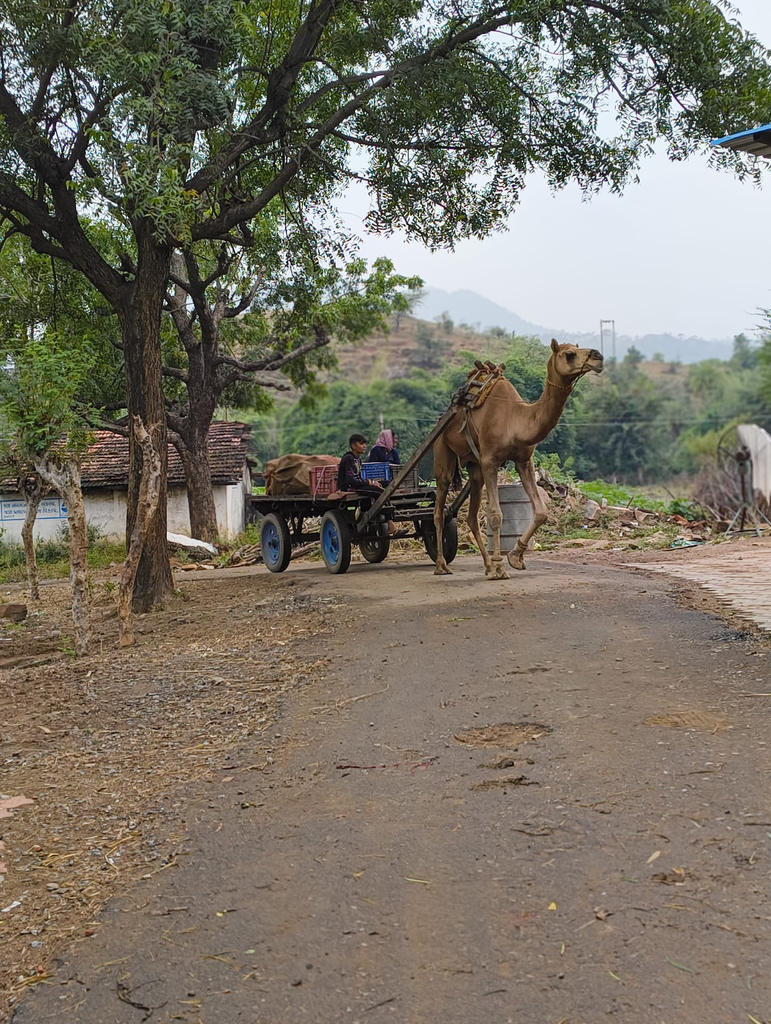
Interestingly, Poshina, a hilly region of Gujarat bordering Rajasthan, reminded me in unexpected ways of my time in the United Kingdom. Not because the two places were particularly alike, but because some details felt strangely familiar: tree-lined roads, bus stops, cows in unexpected places, and relentless rain. I was later told that this weather was far from typical and was itself a sign of a changing climate, creating havoc for cotton farmers in the area.

The differences however, were impossible to ignore. Many houses, often separated by considerable distances, were either kuchha or only partially constructed. I was told that delays and corruption had prevented several government housing projects from being completed.

Although the region is relatively remote, the roadsides were lined with discarded chips packets and biscuit wrappers, a quiet reminder that environmental degradation rarely recognises the boundaries between urban and rural spaces.

Over the next few days, I travelled across Poshina on the back of a motorcycle through winding hills in relentless rain. The cold was biting, and each raindrop hitting my face felt like a tiny needle. It was not the fieldwork experience I had imagined. But the people made the field feel like home. Every conversation, every household that welcomed us in, and every story generously shared, reminded me why I had wanted to come in the first place.

Introduced as the Learner, Not the Researcher

I could not have asked for better facilitators than the staff of our partner organisation, all of whom belonged to Poshina and had chosen to work for their own communities. Looking back, they did the smartest thing in the beginning of every interaction by introducing me, not as the researcher or expert, but as the learner. They told people that they were the knowledge holders in this conversation and that I had come to learn from them.

That simple shift transformed every conversation and my role within it. CBPR is built on the understanding that learning does not flow in only one direction. While I had come to learn from the community, I also found myself sharing my own experiences and perspectives whenever they were useful. Research is at its most meaningful not when knowledge flows in a single direction but when both leave having learnt something they did not know before.

Stories of Strength, Not Just Problems

I was later told that many research conversations people had participated in usually began with questions about problems: What difficulties do you face? What is not working? What do you need? Ours began differently. Instead of telling me what they lacked, people began by showing me what they had.

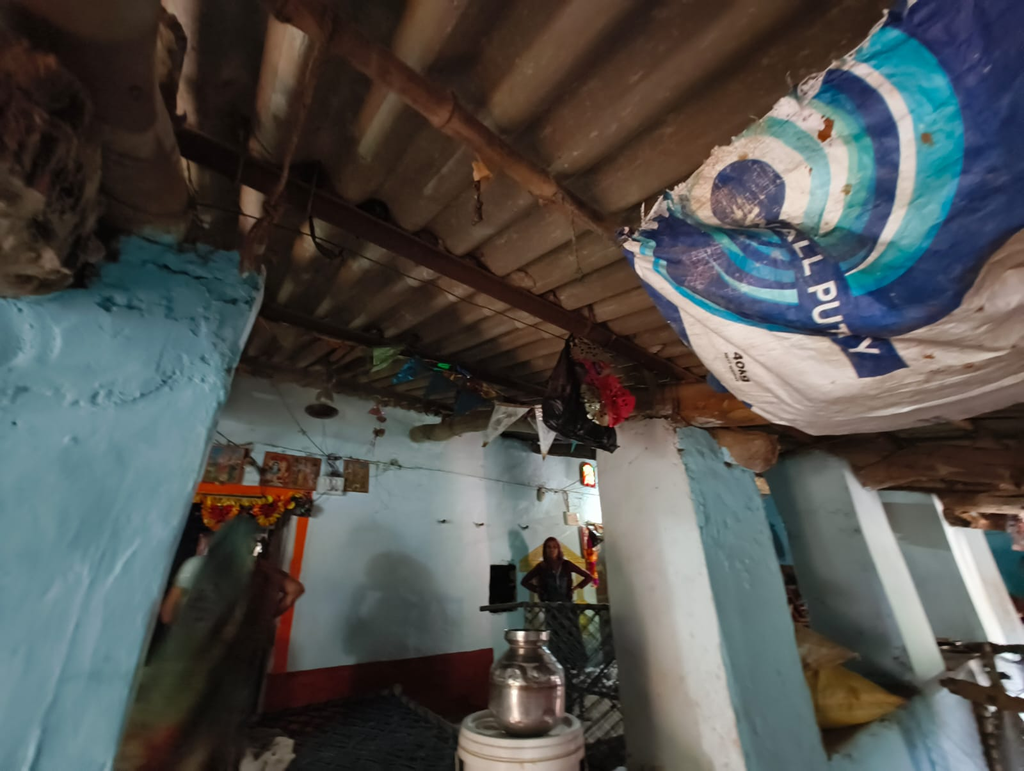
They welcomed me into their homes and shared the knowledge embedded in their everyday lives. They showed me climate-resilient homes built from bamboo and locally available materials. The concrete houses constructed under government schemes were far less suited to the local climate, becoming unbearably hot during summer and cold during winter, while traditional homes remained naturally regulated. One family also showed me a shelf built close to the roof where cooler air naturally collected, allowing it to function as a refrigerator.

Perhaps I had unconsciously assumed that the outcome of good fieldwork would be a long list of problems. Instead, I came back with stories of strengths. Don’t get me wrong- I still learnt about alcohol smuggling, challenges in education and healthcare, climate change, child labour, corruption, and the many forms of marginalisation that shape everyday life in the region. Those realities remained very real.

But alongside them, I encountered resilience, hope, and knowledge produced, tested, and refined through generations of living with the land. I witnessed community, collective problem-solving, and the remarkable potential of young people when they are trusted and empowered.

The Biggest Lesson

The biggest lesson I returned with was that- conversation between academic knowledge and lived knowledge is far more productive than the false choice between them. The communities of Poshina possessed an extraordinary amount of knowledge. What they often lacked was a governance system capable of recognising, supporting, and delivering services that responded to their realities.

Similarly, what many young people needed was not simply an opportunity to leave for cities for a “better life”, but opportunities to build upon the knowledge, skills, and strengths that already existed within their communities.

For years, I had thought that the purpose of fieldwork was to identify problems waiting to be solved. The communities of Poshina reminded me that it is equally about recognising strengths, understanding the knowledge that already exists, and asking what prevents that knowledge from being valued.

The question is not whether communities possess knowledge. It is whether we, as researchers, are willing to create the conditions in which that knowledge is recognised, respected, and placed in conversation with other ways of knowing.

The people of Poshina did not need someone from outside to teach them how to protect their forests, adapt to a changing climate, or live sustainably. If anything, people like me needed to go there and learn how they had been doing it all along.

If we are serious about addressing complex social and environmental challenges, we need researchers who are equipped not only with technical methods, but also with the ability to work alongside communities in ways that are rigorous, participatory, and grounded in mutual learning. It is precisely this approach that PRIA International Academy’s CBPR courses seek to build.

Participatory Snacks at PRIA

Finding Better Questions: Why Gender Mainstreaming Begins with Learning to Notice

My earliest imagination of what the inner workings of a workplace looked like came from sneaking into my father’s office as a child and wandering around the place for the rest of the day. My hobby required a carefully planned strategy. Go with him in the very early hours of the morning and avoid talking to, or being spotted by, anyone I had not already met. My first opponent to hide from was the woman who brought my father his morning tea. Then came his boss, who always seemed to complain about how slowly she worked. I was confused. She seemed to be working more than anyone else on that floor. Everyone else was sitting in front of laptops, and at that age I thought laptops were just video game devices.

After my second visit, I asked my father a question that had been bothering me. Why are the aunties not sitting on your floor? Where are they? What do they do? He told me they also worked in the office but did not sit with his team. Some of them gave him work while others supported him in doing his work. His answer, however, led to another question. If they worked here too, why were they somewhere else?

As I grew up, I found similar arrangements elsewhere. Men teachers and women teachers sat in different spaces in my school staff room. There were very few women on the election posters around my bus stop. Almost every bus driver I saw was a man, while it was overwhelmingly mothers who brought children to the bus stop every morning. I began to realise that the ordinary often concealed unequal ways of organising work, authority and everyday life.

More Reads: PRIA’s Commitment to Gender Mainstreaming: Transforming Governance, Participation, and Everyday Realities

The Question My History Teacher Asked

​ Children reading in a classroom - Licensable at Flickr · Creator: Archives New Zealand​

My history teacher in Class 9 fuelled this curiosity even further. She was teaching us about voting rights after the French Revolution, when estate-based voting was replaced by individual voting. After we finished reading the textbook, she asked, “Did everyone have voting rights in France?”

Most of us answered yes. I assumed that “all propertied and tax- paying men” meant everyone. Then she paused and asked again, “Did it really include everyone?” That hesitation created space for another question.

I raised my hand and asked, “Where are the women? What about the non-propertied men?”

What Gender Mainstreaming Really Means

Looking back, I realise that I was asking questions about the gendered division of labour and political participation long before I knew those phrases existed. I noticed that work was organised differently for women, but I did not yet have the language to understand why. Gender mainstreaming perhaps begins from this simple act of noticing. It asks us to question arrangements that appear natural and to examine how institutions produce unequal experiences for different people.

When I later studied gender and began working in this field, I found myself returning to that moment repeatedly because my teacher had done something much more important than correcting a history lesson. She interrupted what all of us, including the textbook, had accepted as obvious by asking whether “everyone” really meant everyone. She questioned the “normal”. Gender mainstreaming, to me, feels like a similar intervention. It is not simply about bringing more women or gender minorities into existing institutions. It is about questioning the assumptions through which those institutions have been built. It asks whose experiences are treated as the norm, whose concerns are considered important, and whose absence has become so ordinary that it is no longer noticed.

Why This Matters for Organisations

This becomes even more important when we think about organisations and workplaces. The questions I asked as a child about where the women employees were, why they sat separately, or what work they did cannot be answered through a technical checklist. They are rooted in longer histories of how work itself has been organised, how productive and reproductive labour came to be separated, and whose labour came to be recognised as skilled and productive while other forms of work remained invisible.

Representation matters, but it is only one part of a much larger process. Gender mainstreaming asks institutions to examine how decisions are made, who participates in making them, whose experiences inform policies and programmes, and whether seemingly neutral practices reproduce unequal outcomes. It requires us to move beyond asking whether women and gender minorities are present towards asking whether the systems themselves continue to privilege certain experiences.

Gender justice is the goal. Gender mainstreaming is the strategy through which institutions work towards that goal. It asks organisations to use a gender lens in all their activities instead of treating gender as a separate concern. It is a continuous process of questioning institutional cultures, everyday practices and decision-making so that inequality is not reproduced.

Learning to ask these questions is only the first step. They must then become part of how organisations work and reflect on their own practices.

What This Looks Like at PRIA

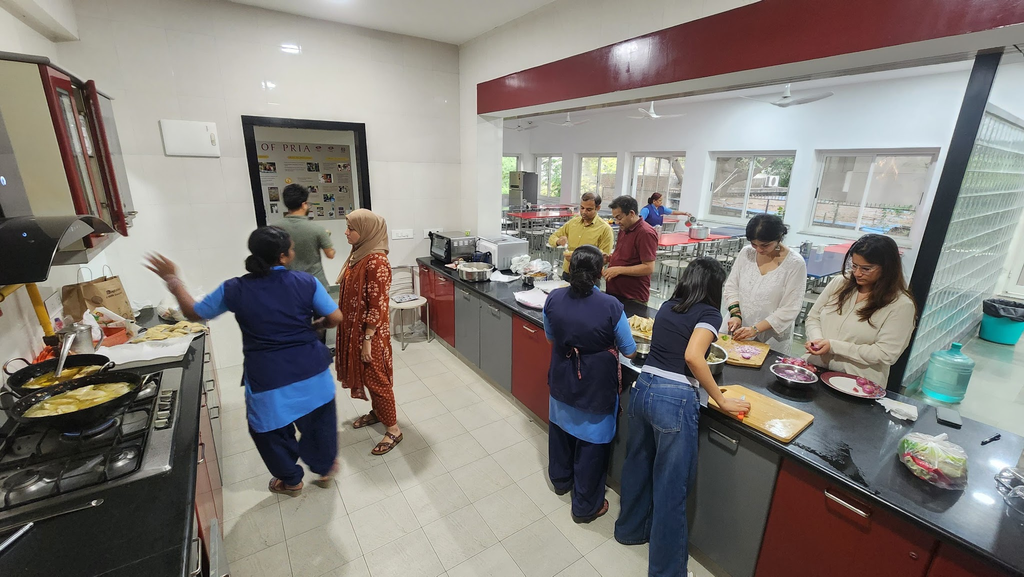
Participatory Snacks at PRIA

I have begun to see what this can look like at PRIA. There is a conscious attempt to recognise how everyday organisational practices can reproduce unequal divisions of labour.

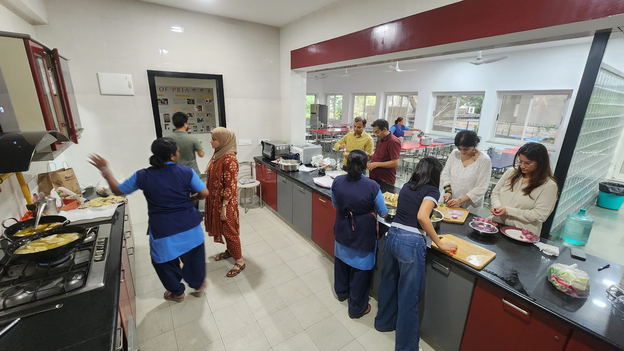
Everyone is encouraged to wash the cups and plates they use rather than leaving care work to someone else. It is a small practice, but it encourages all of us to think about how labour is organised and shared.

Gender is also treated as a cross-cutting concern across programmes, institutional mechanisms and informal spaces. These practices do not suggest that organisations “arrive” at gender justice. They show that workplaces can become spaces of continuous learning where questioning is encouraged.​ ​ ​

Learning to Ask Better Questions

Perhaps this was the process I was looking for when I wandered through my father’s office wondering where the women employees were. Gender mainstreaming is not about arriving at the right answers once and for all. It is about learning to ask better questions, remaining willing to question them again, and creating institutions that are prepared to do the same. PRIA International Academy’s courses on Gender and Development offer an opportunity to explore these questions further, examining how gender shapes institutions, development processes and everyday life, and how we can work towards more transformative change. The journey towards gender justice begins with learning to notice what has long been accepted as ordinary.

For more reflections like this, visit the PRIA International Academy blog.