Author Archives: Sahib Singh Tulsi

How do stories become organisational learning?

Reflections from a Learning Circle on the “Most Significant Change” technique

When I looked back at my notes from a recent Learning Circle on the Most Significant Change technique, I noticed something peculiar. Rather than recording the steps of the method, my notebook was crowded with questions.

Which stories matter?

Who decides?

What gets lost in translation?

A few arrows connected them. Several phrases were circled. The page looked less like a set of notes and more like a conversation with itself.

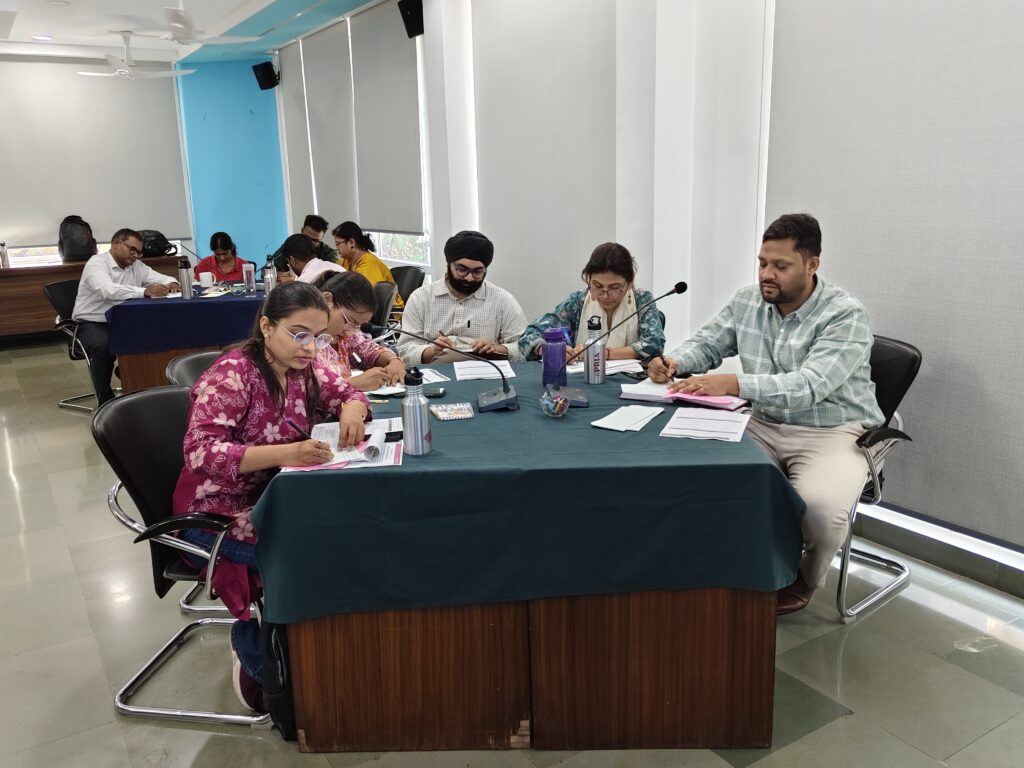
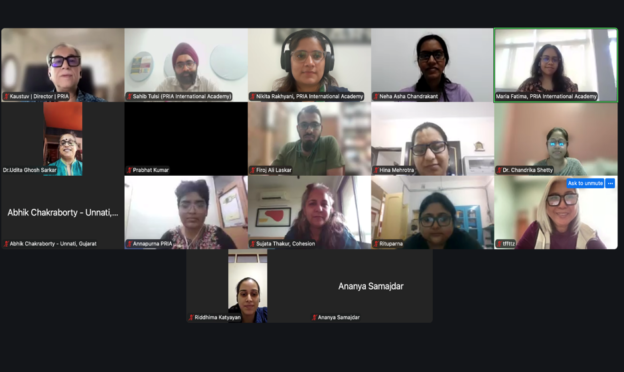
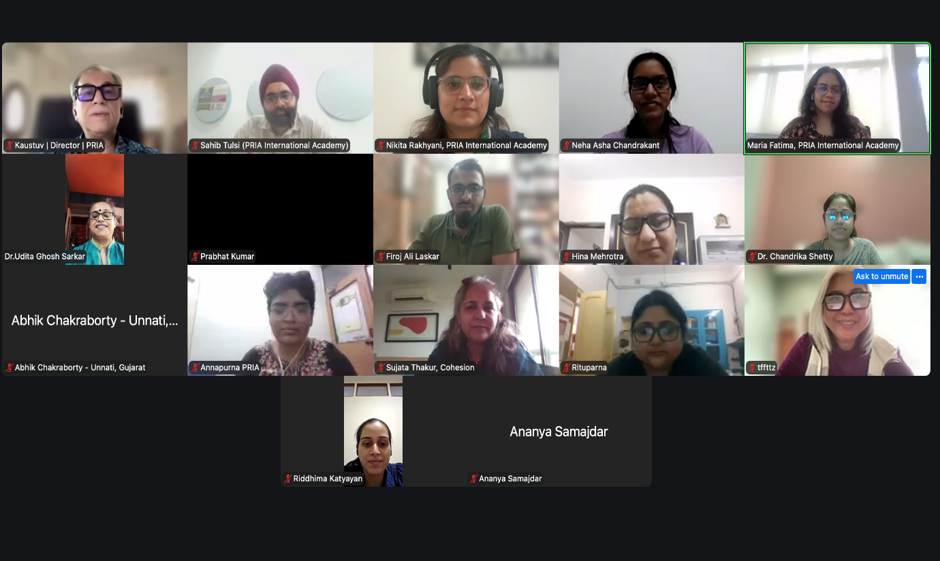
The Learning Circle, organised by PRIA International Academy (PIA), brought together participants from diverse professional backgrounds to explore the Most Significant Change (MSC) technique. It encouraged participants to exchange perspectives, ask questions and explore ideas together. I had joined expecting an introduction to another tool from the world of monitoring, evaluation and learning. What I encountered felt closer to a conversation about stories.

And significance.

MSC uses stories to understand change by inviting participants to share experiences and discuss what they consider most significant and why. The technique itself can be explained in a few sentences. The conversations it generates are another matter. As the discussion unfolded, the conversation shifted towards what made one change more significant than another.

The More We Spoke About Stories…

The question was not only whether change had occurred. It was also about meaning. Which changes do people remember? Which changes do they talk about? Which changes come to represent something larger?

By the end of the Learning Circle, my notebook contained fewer notes on implementation than questions about listening, interpretation and significance.

One comment from the group discussion kept drawing me back to my notes. Stories, a participant observed, do not always travel intact. A story told in one language may acquire a different texture in another. A phrase that carries emotional weight in a community meeting may appear flatter in a report. The challenge is not only whether stories are heard, but how they are carried forward.

What exactly travels when stories move from people’s lives into organisational learning? What gets amplified? What becomes difficult to communicate? And how do we ensure that experiences remain recognisable as they move across languages, institutions and audiences?

Attention soon shifted to the idea of ‘significance.’ What counted as significant seemed to shift depending on who was speaking. A project team might highlight one outcome. Community members might remember something else entirely. Before long, the conversation centred on one question: significant for whom?

Much of development work involves documenting change. MSC invites a different kind of conversation. It encourages people to explain why particular experiences matter to them and to place those perspectives in dialogue with others. Stories become occasions for discussion, disagreement and learning.
Some participants spoke about how stories create space for people to articulate experiences in their own words. Others appreciated the possibility of learning from unexpected outcomes – changes that may never have appeared in a project’s original plans. One observation stayed with me: stories help us notice dimensions of experience that are difficult to capture through numbers alone.

One question kept resurfacing in my notes: what changes become visible when we begin with stories? Perhaps, part of the answer lies in the richness stories carry. They communicate not only events, but also relationships, uncertainties, hopes and meanings. Sometimes they reveal what an experience felt like.

Beyond the Story Itself

Stories occupied the centre of the discussion. What stayed with me, however, was what happened after they were told. As stories moved through conversations, reports and institutions, they gathered new interpretations. A phrase carrying emotional weight in a community meeting could lose some of that meaning in a report. The discussion reminded me that stories do not simply document experiences. They also change as they travel.

One participant observed that storytelling is a skill. That comment opened another line of thinking. Some experiences naturally become stories. Others unfold gradually through changing relationships, growing confidence, new responsibilities or altered ways of seeing the world. Their significance may be deeply felt by those living them, even when they resist neat narration. I left the Learning Circle wondering: Are all meaningful changes equally easy to tell?

The conversation also returned repeatedly to questions of selection and significance. Who decides which stories come to represent change? How are those decisions made? What happens to the many stories that remain in the background? The discussion suggested that listening is only the beginning. Interpreting and selecting stories also require careful judgement. Such judgements require us to remain attentive to whose voices are heard, whose experiences are recognised and whose perspectives may still be missing.

The Learning Circle brought into focus the challenge of recognising what matters in other people’s lives. Participatory methods such as MSC create space for these moments, helping organisations attend not only to what changed, but also to how people understand and assign meaning to those changes. Some changes announce themselves. Others become visible only with time. Perhaps that is why the questions from the Learning Circle continue to linger. Not because they demand answers. Because they change what we notice.

Every method teaches us to notice certain things. The Learning Circle suggested that participatory approaches sharpen our attention to how people understand, negotiate and give meaning to change. If these questions resonate with you, PRIA International Academy offers courses and programmes that explore participatory approaches, community engagement and experiential learning, bringing educators, practitioners and communities into dialogue with one another. We invite you to explore them and continue the conversation with us.
Reflections on Theory of Change and Social Change

Following the Threads: Reflections on Theory of Change and Social Change

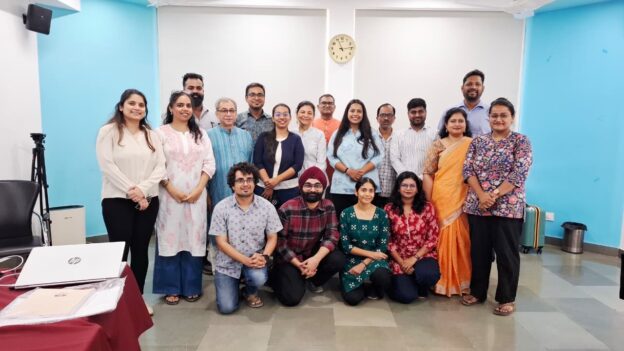
A few weeks into my role at PRIA International Academy, I found myself sitting in a Theory of Change workshop listening to conversations about outputs, outcomes, indicators, assumptions, stakeholders, and pathways of change. It was a language I was only beginning to learn. If this kind of reflective workshop experience resonates with you, read another first-person account from a PRIA workshop.

Coming from a background in ethnographic research with Adivasi youth in Bastar, I was more accustomed to questions than frameworks. The questions that stayed with me were messy ones: How does change happen? Why do some opportunities open up while others remain out of reach? Why do interventions sometimes produce outcomes very different from those intended?

Theory of Change was one of those concepts I had encountered before but never fully understood. I knew it appeared in proposals and strategic plans, but I remained unsure of what it offered as a way of thinking about social change.

Mapping Complexity

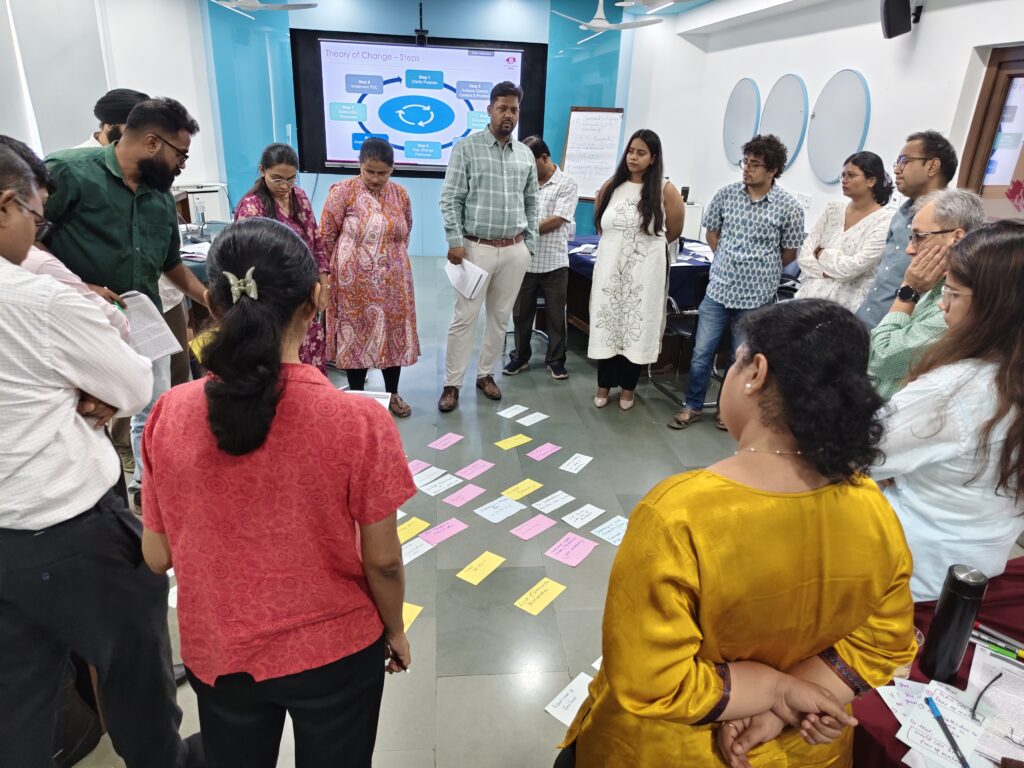
By mid-morning, nobody was looking at the PowerPoint anymore.

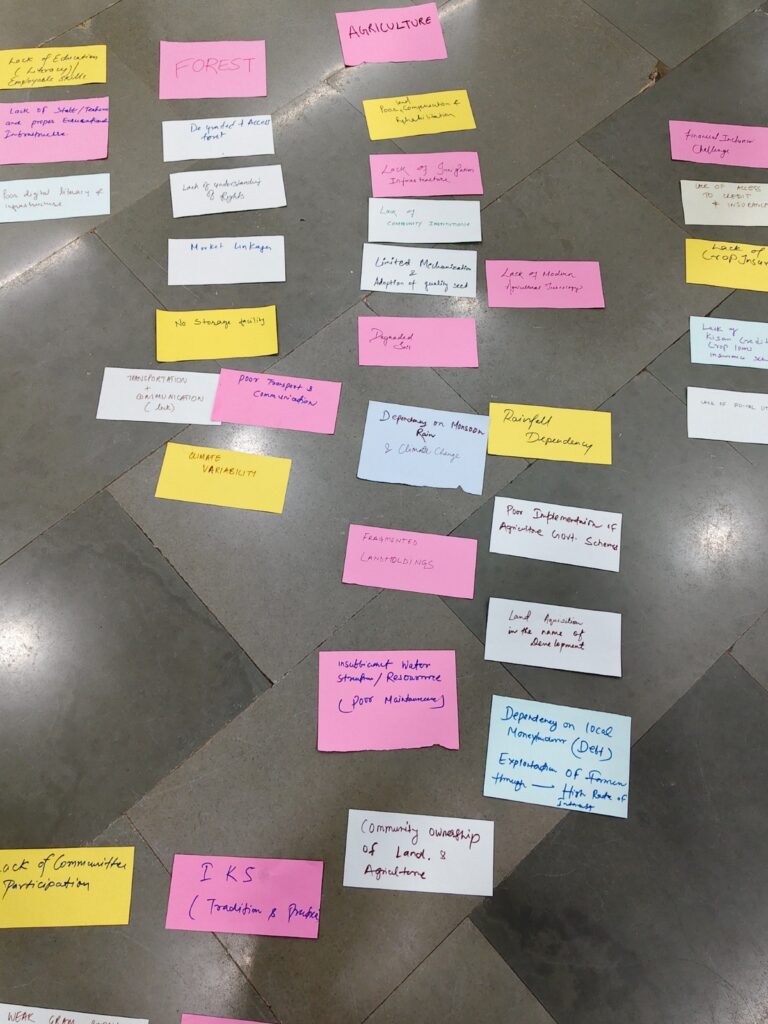
The floor had disappeared beneath coloured slips of paper carrying words such as migration, forest rights, climate vulnerability, women’s unpaid labour, governance failure, and livelihood insecurity. Participants moved them around, debating where one problem ended and another began. Each time someone tried to separate an issue, another thread seemed to pull it back into the web. What had begun as a planning exercise increasingly felt like an exercise in understanding complexity.

At one point, an attempt to place migration at the centre of the diagram was quickly challenged. Others argued that migration itself was only a symptom of deeper pressures – ecological change, insecure livelihoods, weak access to public services, and limited institutional support. The discussion did not settle the question so much as reveal how difficult it was to identify a single starting point.

Reflections on Theory of Change and Social Change

The Promise and Limits of Linear Thinking

I was struck by how much of the discussion depended on formulations that appeared far more orderly than the social realities they were trying to capture. The workshop repeatedly returned to a familiar structure:

If… then… so that.

If communities receive leadership training and institutional exposure, then they may engage more actively with governance systems, so that institutions become more accountable and responsive.

If women gain access to forest-based livelihoods and producer collectives, then livelihood insecurity may reduce, so that migration distress and economic vulnerability decline.

The logic was clear. Reality, I felt, was far less accommodating.

As these examples accumulated, I found myself returning to questions that had shaped my own research. Years of fieldwork had taught me that social life seldom unfolds in neat sequences. Aspirations shift. Institutions respond unevenly. Interventions produce unintended consequences. Cause and effect resist tidy explanations.

For much of the workshop, I sat with that tension. Was Theory of Change attempting to simplify a world that is inherently complex?

Theory of Change and Social Change

A Different Way of Seeing Theory of Change

But as the conversations continued, I began to realise that I had been framing the problem too narrowly. The workshop was not asking participants to predict how change would unfold. It was asking them to articulate the conditions under which change might become possible.

That shift stayed with me.

In that sense, Theory of Change was not a map of reality. It was a way of making our reasoning about reality visible. Explore how Theory of Change can be applied for greater community impact.

Seen in this light, Theory of Change was less about predicting change than making assumptions visible. Why should one activity lead to a particular outcome? What conditions need to exist? Who enables change? Who might interrupt it? What are we taking for granted when we design programmes and interventions?

Tracing the Connections

These questions became especially vivid during a case study on livelihood insecurity among Adivasi communities in Jharkhand. What initially appeared to be a discussion about livelihoods quickly expanded into conversations about forest access, climate vulnerability, migration, agriculture, governance, and public services. The further we traced one issue, the more difficult it became to separate it from the others.

The exercise highlighted how categories such as livelihoods, migration, governance, and climate often function less as distinct sectors than as different entry points into the same social reality. Rather than beginning with activities, the process encouraged participants to start with context, relationships, stakeholders, and the assumptions connecting action to change. See how Community-Based Participatory Research embraces this complexity.

Because every pathway rests on assumptions.

If communities become more aware of their rights, will institutions necessarily respond?

If women participate in collectives, will decision-making structures become more equitable?

If grievance redressal systems exist, are they genuinely accessible to migrant workers facing vulnerability?

Theory of Change and Social Change

Change for Whom?

Gradually, I found myself returning to questions that had accompanied me long before I entered the workshop: change for whom, and defined by whom?

In development practice, terms such as participation, empowerment, inclusion, and accountability can appear self-evident. Yet their meanings are not experienced in the same way by everyone. Increased participation may not carry the same significance across contexts shaped by gender inequality, caste, livelihood insecurity, or institutional exclusion. In many cases, meaningful change involves not only access to services or resources, but also dignity, confidence, recognition, safety, and the ability to negotiate institutions without fear. Learn why PRIA’s participatory approach is more relevant than ever.

Embracing Uncertainty

Community-based change rarely moves from action to outcome. Assumptions prove fragile, contexts shift, and consequences emerge in unexpected ways. What the workshop offered was not a way of simplifying this complexity, but a way of engaging with it more consciously.

As someone newly entering the world of programme design and institutional practice, I left the workshop thinking less about whether social change can ever be fully captured within a framework and more about the value of creating spaces where assumptions can be surfaced, debated, and reconsidered collectively. Such spaces encourage us to become more explicit about the assumptions that guide our actions, the forms of change we seek, and the people whose voices animate those visions. Discover participatory learning methods that enable this kind of shared inquiry.

Following the Threads

Looking back, I find myself returning to the image of those coloured slips spread across the floor. Each attempt to separate one issue from another seemed to reveal yet another connection. By the end of the workshop, the diagram remained messy, unfinished, and open to revision.

Perhaps that is precisely the value of Theory of Change. Not because it untangles the complexity of social life, but because it creates a space to examine the threads more carefully – to ask what we believe, why we believe it, and what conditions might allow change to take root.

If this reflection resonates with you, explore PRIA’s Learning Circles — spaces designed for exactly this kind of collective thinking.