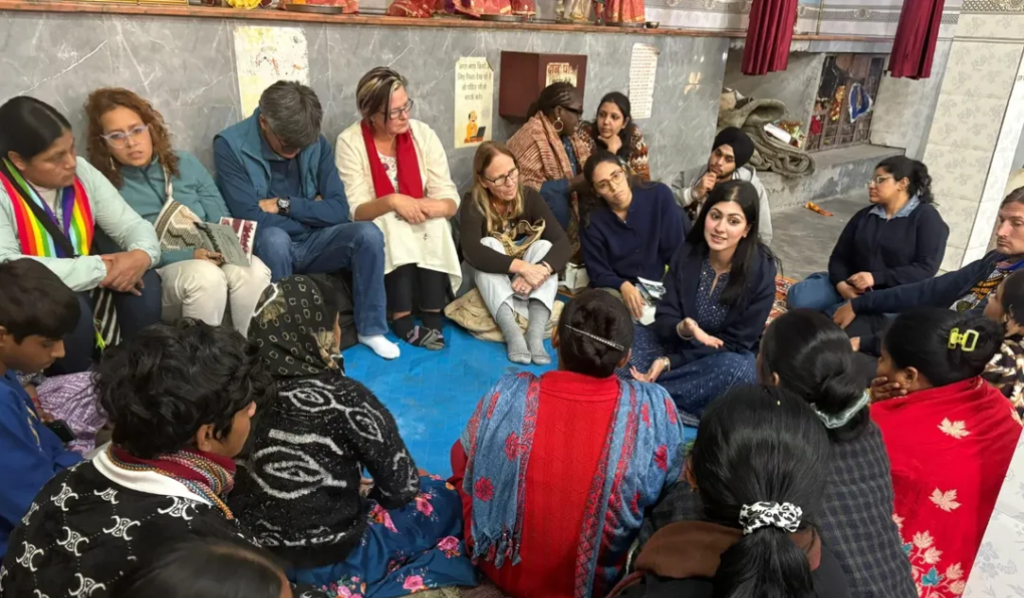
As a girl who has always wanted to save the world, almost every decision I have made has somehow been motivated by that ambition.
At eighteen, I was determined to study Political Science. In my head, that was clearly the degree one pursued before single-handedly fixing the backsliding of democracy, inequality, and climate injustice. Fortunately, fate intervened, and I studied Sociology instead.
Falling in Love with Theory
Sociology gave me exactly the lens I needed to understand society and, more importantly, to fall hopelessly in love with academia. I became convinced that if I could just learn enough theory, identify the right conceptual framework, and describe social problems in the pristine vernacular of what is technically English but functionally a completely different language called Academia, I would surely save the world.
So I did what any aspiring world-saver would do. I memorised Marx, Weber, and Durkheim. I learnt exactly where to quote Bourdieu and Freire, and where to bring in Foucault for effect. I developed the useful academic skill of confidently using words like “hegemony,” “epistemology,” and “dialectical materialism” in everyday conversations.
I was certain I was on the right path. Imagine my surprise, then, when the world refused to transform despite me quoting every line of Santos’ theory of absences.
More Reads: Why CBPR is the Future of Ethical and Inclusive Research
The Crisis in Winston Churchill Hall
The real crisis arrived during my Master’s degree.
There I was, studying at the world’s leading development institute, located in the world’s most developed country: the United Kingdom. And yet, for all the brilliant ideas I encountered, something felt off.
I loved the theories. I loved the debates. I loved reading the works of my favourite white-bearded intellectuals who seemed to have a theory for every social problem humanity had ever produced. But increasingly, I found myself wondering whether theory alone was enough for the kind of justice I cared about. If this had all been talked about already, why had it not been solved yet? The moment this contradiction fully hit me was while studying food justice sitting in Winston Churchill Hall.
As I sat writing essays on feminism, carefully citing Simone de Beauvoir and Patricia Hill Collins, I realised that the woman who defined feminism for me, my mother- could not read what I was writing.
Who was I writing for? Who was I fighting for?
Had I really spent years and, an alarming amount of money only to purchase a higher floor in the Ivory Tower?
More Reads: How to Apply the Theory of Change for Greater Impact in Community Development
Writing About People I Never Met
The questions only became harder when I began writing my dissertation.
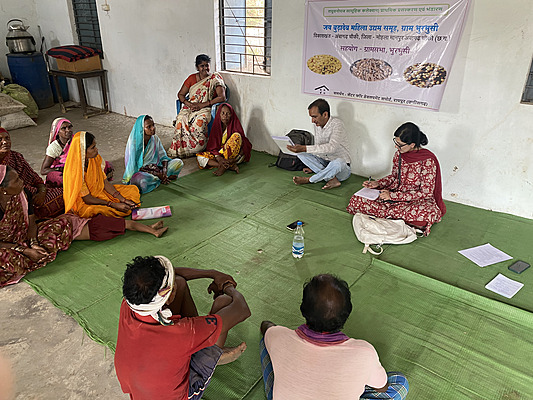
My research explored the intersections of caste, class, gender, and environmental vulnerability in Rajasthan. I spent months analysing heat action plans and critiquing policy responses to climate change. I wrote in a language that was technically English but the kind that requires three subordinate clauses, two citations, and a theoretical framework before one is permitted to make a point. After all, plain English might communicate an idea effectively, but it certainly would not get me a distinction.
The deeper I got into the thesis, the more I realised- the people whose lives I was writing about would never read my work. And the audience most likely to read it consisted of people who would never experience a forty-eight-degree heatwave in a semi-arid region, spend hours searching for water, or navigate the realities I was trying to describe.
I had entered academia because I wanted to contribute to social change.
Yet somewhere along the way, I started producing knowledge about people without ever truly engaging with them.
Finding PRIA
It was during what I can only describe as a full-blown existential crisis that I came across a job opening at Participatory Research in Asia– affectionately known as PRIA.
The irony was that I already knew of PRIA. I had encountered its work during my research methodology classes at Delhi University. Unfortunately, at the time, most of my attention was occupied by Gouldner and Mead.
By this point, I was desperate for an alternative to reading one more heat action plan- devoid of anything that people on the ground actually told me. So I applied. At the time, I thought I was simply applying for a job. Looking back, I realise I was looking for a way back to the reason I had entered this field in the first place.
April 2025 marked the beginning of that journey. Or, to put it less academically and more accurately, it was the month I finally felt like myself again.
Over the coming months, I was introduced to community-based participatory research (CBPR), the UNESCO Chair in Community-Based Research and Social Responsibility in Higher Education, the Knowledge for Change (K4C) Global Consortium, and the DECODE project. At the time, I did not realise that these would fundamentally change how I understood research, knowledge, and my own role as an academic.
The Feedback That Changed Everything
In my very first month at PRIA, I was asked to write a paper on the social responsibility of higher education.
Finally, I thought. My time had come.
Armed with four years of Sociology and Development Studies, I produced what I thought was a masterpiece; a pristine, sanitised, thoroughly academic 2,000-word essay. Every theorist I had lovingly collected over the years made an appearance. If there was a theory that could explain why higher education needed to transform, I had included it. If there was a critical scholar who I knew written about power, knowledge, justice or exclusion, they were probably cited.
I submitted it with the confidence of someone who was absolutely certain they had done an excellent job. However, instead of praise, I received feedback.
Now, I should clarify that feedback and I have never had the easiest relationship. Like many young academics, I was deeply attached to my writing and even more attached to the illusion that I had figured things out.
But this particular feedback changed something. The feedback itself was remarkably simple: “Whatever theory you write, however much you write, it means very little if it is not connected to the ground you are working on.” In many ways, it felt like somebody had finally connected all the loose threads I had been carrying through four years of higher education.
I had spent years learning theories about power, inequality, exclusion, and justice. I could explain social problems in increasingly sophisticated language. I could critique systems, analyse structures, and identify forms of oppression. But somewhere in the process, I had begun to confuse understanding a problem with being connected to it.
That feedback forced me to confront a difficult possibility: perhaps knowledge is not valuable simply because it is theoretically sound but because of its relationship to people’s lived realities.
What Participation Actually Means
For the first time, I began to understand what participation actually meant.
Participation was not about adding a quote from a community member to make research appear inclusive. It was not about conducting a consultation and then returning to business as usual. Participation meant recognising that people are not merely subjects of knowledge; they are producers of it. It meant understanding that stories matter because people matter.
It meant recognising that change does not happen because a theory is elegant or because an academic argument is convincing. Change happens because people organise, struggle, negotiate, imagine, and act. And if research is disconnected from those realities, it risks reproducing the same injustices it sought to remedy.
I have tried to never write the same way since.
To this day, every time I sit down to write, that feedback follows me.
Who is this for? Whose reality does it speak to? And what happens if the people most affected by the issue I am writing about never see themselves in the work?