Archives

Participatory monitoring and evaluation

Participatory Monitoring and Evaluation

What if the people affected by a programme were also the ones judging its success and failures? That is the thinking behind participatory monitoring and evaluation. Below, we walk through what the term means, why it exists, how it works in practice, and where you can see it changing how programmes are judged.

What is Participatory Monitoring and Evaluation?

Participatory monitoring and evaluation hands the job of checking whether a programme worked to the people it was meant to help, rather than to an outside expert alone.

More formally, participatory monitoring and evaluation is an approach that strengthens organisational learning and accountability by directly involving primary stakeholders, especially communities and beneficiaries, in assessing processes and outcomes.

Why It Matters

Most evaluations happen to a community, not with it. Participatory monitoring and evaluation flips that, putting communities and beneficiaries at the centre of the review instead of the sidelines.

That shift does two things at once. 

  • It strengthens organisational learning, since the people closest to the work spot problems outsiders miss.
  • It builds real accountability, because findings come from those directly affected. 

Above all, it turns evaluation into shared reflection rather than an outside verdict handed down after the fact.

How It Works

The people involved are the ones usually left out. Primary stakeholders, communities, and beneficiaries take an active role, sitting alongside programme staff rather than answering to them.

What they assess is both processes, how the work was carried out, and outcomes, what actually changed as a result. The real shift is in purpose. Instead of an external evaluator delivering a pass-or-fail judgement, the group reflects together on what worked, what did not, and what to fix next. Evaluation stops being a scorecard and becomes a tool for collective improvement.

Real-World Examples

The clearest examples come from work where communities hold the pen.

  • Community-led programme reviews, common in rural development projects, gather villagers to score and discuss a scheme’s progress in their own words. 
  • Beneficiary feedback processes in health and education programmes let the people using a service flag gaps that official reports overlook. 
  • Community scorecards, used across parts of India and Africa, bring residents and providers into the same room to rate services and agree on fixes together.

Key Takeaway

Participatory monitoring and evaluation is accountability built from within. When the people a programme serves also judge it, evaluation becomes honest, grounded, and genuinely useful for making the work better.

Explore More

Found this useful? Bookmark this page and share it with anyone working in development, policy, or programme design. To go deeper, browse related glossary terms such as Evidence-Based Policymaking and Citizen Report Card, both of which sit closely alongside how communities hold programmes to account.

If you’d like to build practical expertise in this area, take a look at our course on Participatory Monitoring, Evaluation and Learning.
Social Accountability

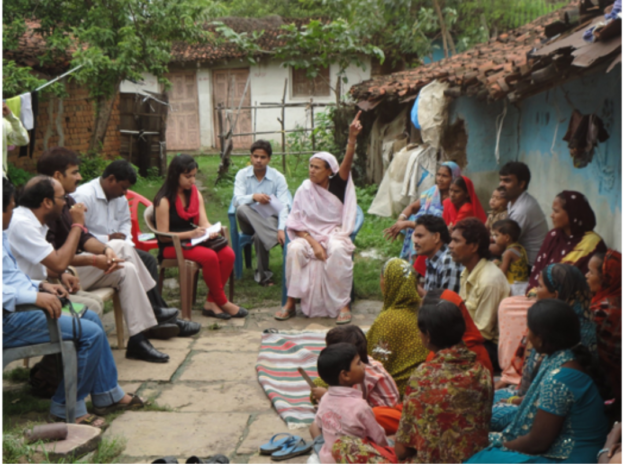
Social accountability is an important part of democratic governance and citizen participation. It refers to the ways in which citizens and communities engage with public institutions to improve transparency, accountability, and responsiveness. It encourages people to participate in monitoring public services, raising concerns, and seeking action from the institutions responsible. 

Social Accountability strengthens the relationship between citizens and institutions by creating opportunities for participation, feedback, and dialogue.

What is Social Accountability?

In simple terms, social accountability is the process through which citizens hold public institutions accountable for their actions, decisions, and performance.

More formally, it refers to citizen-driven processes that monitor institutions and demand responsiveness in the delivery of essential public services and governance functions.

It exists because accountability is not only the responsibility of oversight bodies and government systems. Citizens and communities also play an important role in ensuring that institutions remain responsive to public needs and priorities.

Why Social Accountability Matters

Social accountability helps strengthen transparency and trust between citizens and institutions.

It encourages public institutions to be more responsive to the needs and concerns of communities while improving the quality and effectiveness of public services.

It also creates opportunities for citizens to participate in governance processes and contribute to decisions that affect their lives and communities.

How Social Accountability Works

Social accountability works by creating channels through which citizens can engage with institutions and raise issues affecting their communities.

Citizens may collect information, review public records, assess service delivery, or participate in public consultations. Institutions are expected to respond by sharing information, addressing concerns, and taking corrective action where necessary.

Common tools include social audits, community scorecards, citizen report cards, public hearings, and grievance redress mechanisms.

Examples in Practice

  • Social Audits under MGNREGS, India

Community members review official records and compare them with work completed on the ground. These exercises have helped identify gaps in implementation and brought attention to issues such as delayed wage payments and irregularities in programme delivery. (Source)

  • Community health monitoring, Uganda 

Local communities assessed health centres based on factors such as medicine availability, staff attendance, and service quality. The findings were discussed with health workers and local authorities to address concerns raised by community members. (Source)

  • Citizen report cards, Bangalore 

Residents shared feedback on public services such as water supply, transport, and waste management. The results highlighted areas where citizens were dissatisfied and encouraged service providers to respond to public concerns. (source)

Key Takeaway

Social accountability strengthens the connection between citizens and institutions by creating opportunities for participation, transparency, and public oversight.

It helps ensure that public institutions remain responsive to community needs while strengthening transparency and public participation.

Want to learn More?

Social accountability is closely linked to concepts such as participatory governance, civic engagement, citizen participation, transparency, and public accountability.

If you would like to explore this topic in greater depth, the Beginner’s Guide to Social Accountability and Participation offers a practical introduction to the principles, tools, and approaches for strengthening accountability and citizen engagement in governance.

theory of change glossary

Theory of Change

It’s one of the most-used phrases in the sector, and one of the most loosely understood too. Get it right, and it stops being jargon. It becomes the thing that actually makes your programme work.

What is a Theory of Change?

A Theory of Change is a roadmap that lays out how and why you expect change to happen. It connects the dots between what you’re doing today and the impact you’re hoping for years down the line, step by step, instead of leaving that connection to hope.

In reality, that means: naming your activities, the outcomes each should lead to, and the assumptions that must hold for one step to lead to the next. Most programmes skip straight from “here’s our activity” to “here’s our impact,” and quietly assume the middle will sort itself out. A Theory of Change won’t let you skip that part. It makes you spell out the thinking teams usually leave unsaid, even to themselves.

Why Does it Matter for you?

Building a Theory of Change challenges you to test your assumptions before the budget’s spent, not after. It also makes evaluation possible in the first place, since you can only track progress against a path you’ve actually written down. And when someone asks “how do you know this will work?”, it gives you a real answer instead of good intentions.

More Reads: Grassroots Leadership

How does it work?

Most teams start by picturing the end goal: the big change they’re ultimately after. Then they work backwards, asking what has to happen right before that. Each step back uncovers another assumption worth checking.

The output is usually a map or diagram showing that chain of steps. But the diagram itself isn’t really the point; it’s just a record of the thinking. The real value happens while you’re building it.

Real-World Examples!

Say for example a maternal health programme wants to cut mortality rates. Working backwards, the team asks: what has to happen right before that? More women delivering at clinics. What has to be true before that? Transport to reach one. Suddenly, training birth attendants (the original plan) isn’t enough on its own, because it assumes transport that may not exist.

A livelihoods project runs into the same problem. Skills training looks like a clear win, until working backwards raises an uncomfortable question: does the market for those skills actually exist in that location?

This is exactly what a ToC is for. Catching the gap before you’ve already spent the budget finding out the difficult way.

Key Takeaway for you

A Theory of Change was never meant to be paperwork for a donor report. It’s really just a habit of brainstorming and not letting optimism or pessimism get in the way of rational thinking. It challenges us to commit to a plan that keeps teams honest and gives evaluation something real to measure.

Conclusion

If you’ve ever struggled to answer “what’s your Theory of Change?”, you’re not alone. PRIA International Academy’s Theory of Change for Greater Impact course helps you build one that actually holds up in practice.

UNESCO Chair in Community-Based Research

What happens when universities begin to see communities not simply as places to conduct research, but as partners in creating knowledge?

That question is central to the UNESCO Chair in Community-Based Research and Social Responsibility in Higher Education. This international initiative brings together universities, researchers, civil society organisations and communities to strengthen community-based research and make higher education more socially responsible.

What Is the UNESCO Chair in Community-Based Research?

Established in 2012, the UNESCO Chair in Community-Based Research and Social Responsibility in Higher Education is jointly based at the University of Victoria in Canada and Participatory Research in Asia (PRIA) in India. Dr Rajesh Tandon and Prof. Budd Hall co-chair it.

The partnership itself is significant. It connects a university in the Global North with a civil society and practitioner organisation in the Global South, bringing different traditions of research and learning into conversation.

At the heart of the Chair is a simple idea: valuable knowledge exists both within and outside universities. Communities have knowledge shaped by lived experience, local histories and everyday problem-solving. Community-based research creates ways for this knowledge to contribute meaningfully to research, learning and action.

Why Does It Matter?

For a long time, academic research has often treated communities primarily as sources of information. Researchers would collect data, analyse it elsewhere and publish their findings, while the people who contributed that knowledge might have little influence over the process.

Community-based research asks for a different relationship.

It encourages universities and communities to identify questions together, learn from one another and produce knowledge that can respond to real social challenges. This approach is closely connected to knowledge democracy, which recognises that there are multiple ways of knowing and producing useful knowledge. PRIA International Academy’s own courses offer another route in for students who want hands-on grounding in these methods without needing a formal university affiliation.

How Does the UNESCO Chair Work?

The Chair works across three broad areas: research, training and policy advocacy. It builds partnerships among universities, civil society organisations, practitioners and policymakers while creating opportunities to learn and practise community-based research.

One example is the Knowledge for Change (K4C) Consortium, which supports training in community-based participatory research through a growing international network.

The Chair has also supported publications, international learning initiatives and work around Open Science and the democratisation of knowledge.

Key Takeaway

The UNESCO Chair in Community-Based Research helps bring communities and universities into a more equal relationship around knowledge. Its work demonstrates that research can be academically rigorous while also being participatory, locally grounded and useful to the people whose lives it seeks to understand.

To explore these ideas further, discover PRIA International Academy’s learning resources on participatory research, community engagement and knowledge democracy.

Urban governance

Urban Governance

What if cities were planned by, and for, the people living in them? That is the idea behind urban governance. This page breaks down what the term means, why it exists, how it works in practice, and where you can see it playing out in real cities today.

What is Urban Governance?

Urban governance is how a city is run, and who gets a say in running it. It covers the decisions behind roads, water, housing, and waste, and whether ordinary residents have a voice in those decisions.

More formally, urban governance is the participatory and accountable planning, budgeting and service delivery in cities that recognises migration, informality and climate vulnerability while promoting inclusive and locally led urban development. It exists because cities grow faster than old top-down systems can manage, and people living there deserve a hand in shaping them.

Why It Matters

  • Urban governance decides whether a city works for everyone or only for a few. 
  • Done well, it makes planning inclusive and holds authorities accountable for what they deliver.
  • It also faces the real conditions cities live with, rather than ignoring them. 
  • Migration fills cities with new residents. Informal settlements house millions. 
  • Climate risk threatens low-lying and unplanned areas first. 

How It Works

Urban governance operates across three main functions: planning how a city develops, budgeting how its money gets spent, and delivering the services people rely on everyday basis. These are not handled behind closed doors alone.

It also accounts for the messier side of city life, from migrant populations and informal housing to areas exposed to flooding and heat. The core of it is shared power. Citizens, local bodies, and institutions work together through consultations, ward committees, and participatory budgeting, so the people affected by decisions actually help shape them.

Real-World Examples

The clearest examples show up where cities include, rather than ignore, their most vulnerable residents.

  • Participatory budgeting, first made famous in Porto Alegre, Brazil, lets residents vote directly on how part of the city budget gets spent. 
  • In India, slum upgrading schemes have brought informal settlement residents into planning talks over water, sanitation, and secure tenure. 
  • Ward committee systems in several Indian cities give neighbourhood-level bodies a formal say in local service delivery, turning residents into active participants rather than passive recipients.

Key Takeaway

Urban governance is the foundation of liveable, inclusive cities. When planning, budgeting, and services are shared openly with the people who live there, cities become fairer, more resilient, and genuinely built for everyone.

Explore More

Found this useful? Bookmark this page and share it with anyone working on cities, policy, or community planning. To go deeper, explore related glossary terms such as Local Governance and Participatory Governance, which sit closely alongside how modern cities are run.

You may also find our piece on decentralisation in government useful for understanding how power shifts from central to local authorities.

youth led participation

Youth Participation

Young people are often at the centre of conversations about education, employment, public spaces and community development. Yet they are not always part of the conversations themselves. Youth participation changes this by creating meaningful ways for young people to contribute to decisions that affect their lives.

What Is Youth Participation?

Youth participation means the meaningful involvement of young people in decisions, activities and institutions that affect them and their communities.

It can happen in many ways. Students may contribute to decisions within their school or college. Young residents may raise neighbourhood concerns with local authorities. Others may participate through youth groups, community research, volunteering, campaigns or advisory bodies.

But participation is more than inviting a few young people to attend a meeting. They need to understand what is being discussed, feel comfortable expressing disagreement and, importantly, know that their contribution can influence what happens next.

Why Does Youth Participation Matter?

Consider a programme designed to improve employment opportunities for young people. Adults may decide what training should be offered, when sessions should take place and what support participants need.

Young people themselves might point out something completely different: perhaps the training does not match available jobs, timings clash with college, or travel costs make attending difficult.

Without their perspective, even a well-intentioned programme can miss important realities.

Youth participation helps institutions understand these experiences. It can also help young people develop skills in communication, problem-solving, leadership and collective decision-making while becoming more engaged with their communities.

How Does Youth Participation Work?

Participation can happen through student councils, youth clubs, advisory groups, community meetings, local governance forums and participatory research. Young people might help identify an issue, gather information, suggest solutions, plan an activity or review whether an initiative has worked.

For participation to be meaningful, however, adults and institutions must be willing to share some decision-making power. Young people may also need information, mentoring and opportunities to develop skills so they can participate with confidence.

A useful question is: What are young people actually being allowed to influence? If every important decision has already been made, participation can easily become symbolic.

What Does Youth Participation Look Like in Practice?

A youth council might identify the need for safer public spaces and present recommendations to local authorities. Students could work with teachers to improve school policies. Young people might conduct community research on employment, education or public services and use their findings to start conversations with decision-makers.

Key Takeaway

Youth participation means recognising young people as contributors, not simply beneficiaries. When their experiences and ideas genuinely influence decisions, participation can strengthen both the programmes created for young people and their engagement with community life.

Explore PRIA International Academy’s learning resources to understand how youth participation connects with participatory governance, community engagement and youth-led change.